Children can safely begin learning the basics between ages three and five by focusing on balance and utilizing properly sized equipment. Successful kids skateboarding for beginners requires consistent use of safety gear like helmets and pads to build confidence while mastering fundamental movements.
Watching your child step onto a skateboard for the first time often triggers a mix of pride and pure anxiety. Many parents worry about the inevitable falls or feel overwhelmed by the aisles of plastic toy boards that offer little stability. However; proper preparation transforms this daunting sport into a powerful lesson in resilience and physical coordination. At Malibu Skate Academy; we believe the difference between a frustrating afternoon and a lifelong passion lies in the technical details. This guide provides a professional roadmap for your child's journey. You will learn how to identify quality equipment; master the essential first five steps of board control; and manage the fear factor through safe falling techniques. We also highlight the best local spots across Malibu and Los Angeles to ensure your young skater begins their journey with the safety and expert guidance they deserve.
Understanding the Best Age to Start Skateboarding
Determining when a child is ready for their first board involves balancing enthusiasm with physical readiness. While some local parks might feature toddlers on boards, the American Academy of Pediatrics (AAP) recommends against skateboarding for children under the age of 5. At this early stage, a child’s high center of gravity and developing neuromuscular system make them more prone to falls that their bodies are not yet equipped to handle safely.
At Malibu Skate Academy, we find the ideal window for beginning skateboarding lessons for kids starts at age 7. By this age, most children have reached a developmental milestone where their fine motor skills and cognitive focus align. This allows them to process the technical nuances of certified 1-on-1 coaching, such as weight distribution and ankle articulation, rather than just standing on the board. When teaching kids skateboarding for beginners, we prioritize this age group because they can follow multi-step safety protocols and maintain the concentration required for a productive session.
As students enter their teenage years, from 13 to 18, their physical coordination often reaches its peak. These older beginners possess the strength to execute more powerful movements, yet this phase also brings a natural increase in risk-taking behavior. Professional instruction during these years is vital to channel that athletic energy into controlled, technical progression rather than raw trial and error. If you are uncertain about your child's readiness, we recommend booking a free introductory lesson to assess their balance and interest in a professional, controlled environment.
Essential Safety Gear for Young Beginners
Once a student is physically ready for the board, the next priority is establishing a baseline of protection. In skateboarding, safety gear is not merely a precaution; it is a tool that allows a beginner to progress by removing the immediate fear of injury. Parents should distinguish between professional-grade protection and the toy gear found in big-box retailers. Professional pads utilize high-density EVA foam and impact-resistant caps that absorb energy, whereas toy sets often feature thin plastic shells that can crack or slide out of position during a fall.
At Malibu Skate Academy, we require four non-negotiable pieces of equipment for every session. A CPSC-certified helmet is the most critical, specifically one designed for skateboarding to protect the back of the head. While knee and elbow pads are standard, wrist guards are arguably the most vital yet frequently overlooked component for beginners. When a skater loses balance, their natural instinct is to reach out and break the fall with their hands. Wrist guards feature rigid splints that prevent hyperextension and allow the hands to slide across the pavement, redirecting the force of the impact.
Essential Gear | Specification | Purpose |
|---|---|---|
Helmet | CPSC-Certified | Protects against rear-impact head injuries. |
Wrist Guards | Rigid Palmar Splints | Prevents fractures by allowing hands to slide. |
Knee Pads | Hard-Shell Caps | Enables the "kneepad slide" safety technique. |
Elbow Pads | Secure Strapping | Protects against abrasions and joint impact. |
During certified 1-on-1 coaching, we ensure that all gear fits snugly against the body. Equipment that is too loose will shift during a fall, rendering it ineffective, while gear that is too tight can distract the skater. Our goal is to ensure each student feels empowered by their gear, not encumbered by it. When a child trusts their equipment, they can focus entirely on their skateboarding lessons for kids and the technical fundamentals of the sport.
Choosing a Real Skateboard vs. a Toy Board
The board itself is the most important piece of equipment your child will use. Many parents are tempted by thirty dollar boards at big-box retailers; however, these toy boards often pose a significant safety hazard. A professional skateboard uses high-rebound urethane wheels that grip the concrete. In contrast, toy boards use hard plastic wheels that slide unpredictably on smooth surfaces, often leading to avoidable slips. Furthermore, professional-grade bearings are designed to roll smoothly with minimal effort, whereas cheap bearings are often stiff or seize up, forcing a beginner to work harder and lose their balance more frequently.
When selecting a setup for kids skateboarding for beginners, size and material are critical. Standard adult decks are too wide and heavy for a child to maneuver effectively. We recommend a narrower deck, typically between 7.25 and 7.75 inches, which allows smaller feet to control the board's edges. Quality decks are constructed from seven plies of North American maple, providing the necessary pop and durability to withstand consistent use.
Component | Toy Board Features | Professional Board Features |
|---|---|---|
Wheels | Hard Plastic (No Grip) | High-Rebound Urethane (High Grip) |
Bearings | Stiff, Non-Responsive | Smooth, Precision-Shielded |
Deck | Compressed Wood or Plastic | 7-Ply North American Maple |
Trucks | Plastic or Weak Alloy | High-Grade Aluminum |
For the best results, visit a local Malibu or Westside LA skate shop rather than a general sporting goods store. A specialist can assemble a custom setup tailored to your child's specific height and shoe size. Starting with the right equipment ensures that during certified 1-on-1 coaching, your child focuses on technique rather than fighting their gear. If you are unsure if your current board is suitable for skateboarding lessons for kids, bring it to a free introductory lesson for a professional assessment.
The First Five Steps to Board Confidence
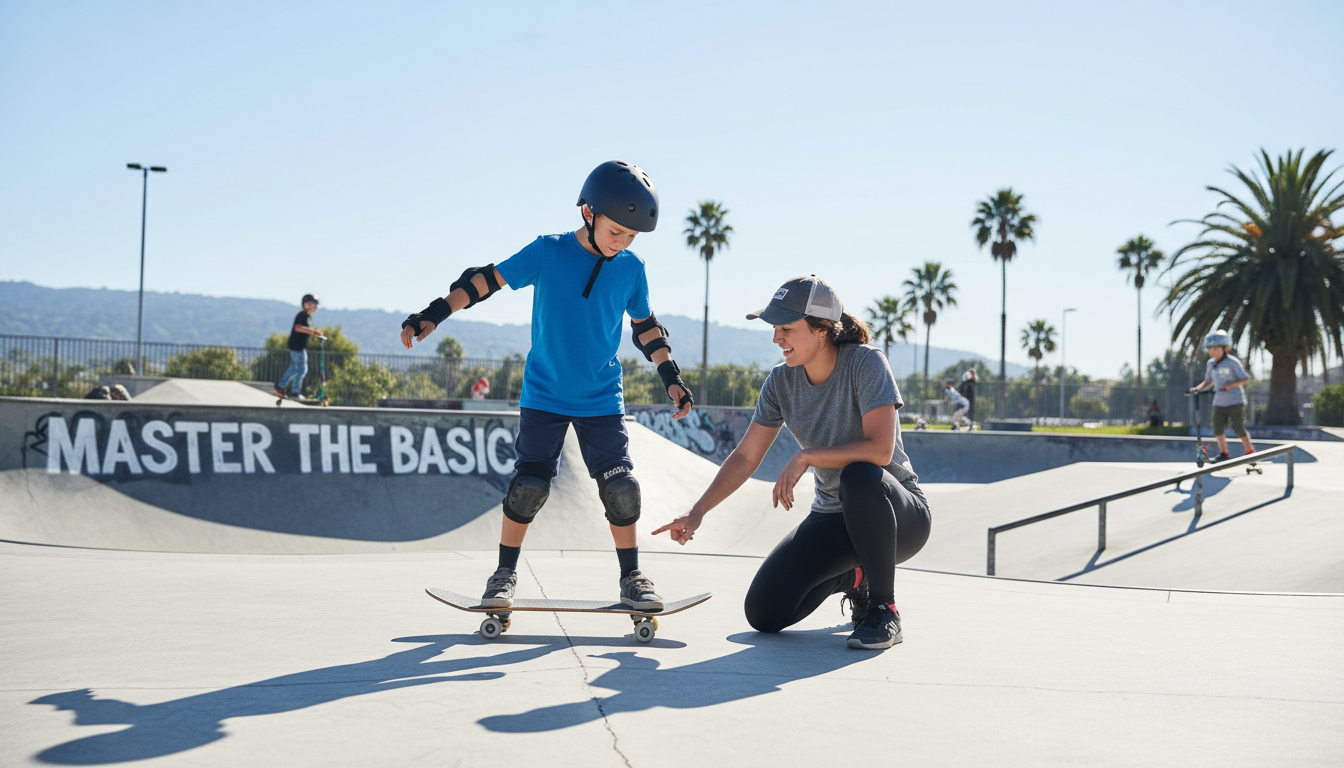
Building confidence on a skateboard requires a structured progression that moves from stationary stability to controlled motion. At Malibu Skate Academy, our certified 1-on-1 coaching follows a specific five step sequence designed to build muscle memory while minimizing the risk of an early fall. Mastering these mechanics on flat, smooth concrete is the primary safeguard against the common injuries associated with loss of balance.
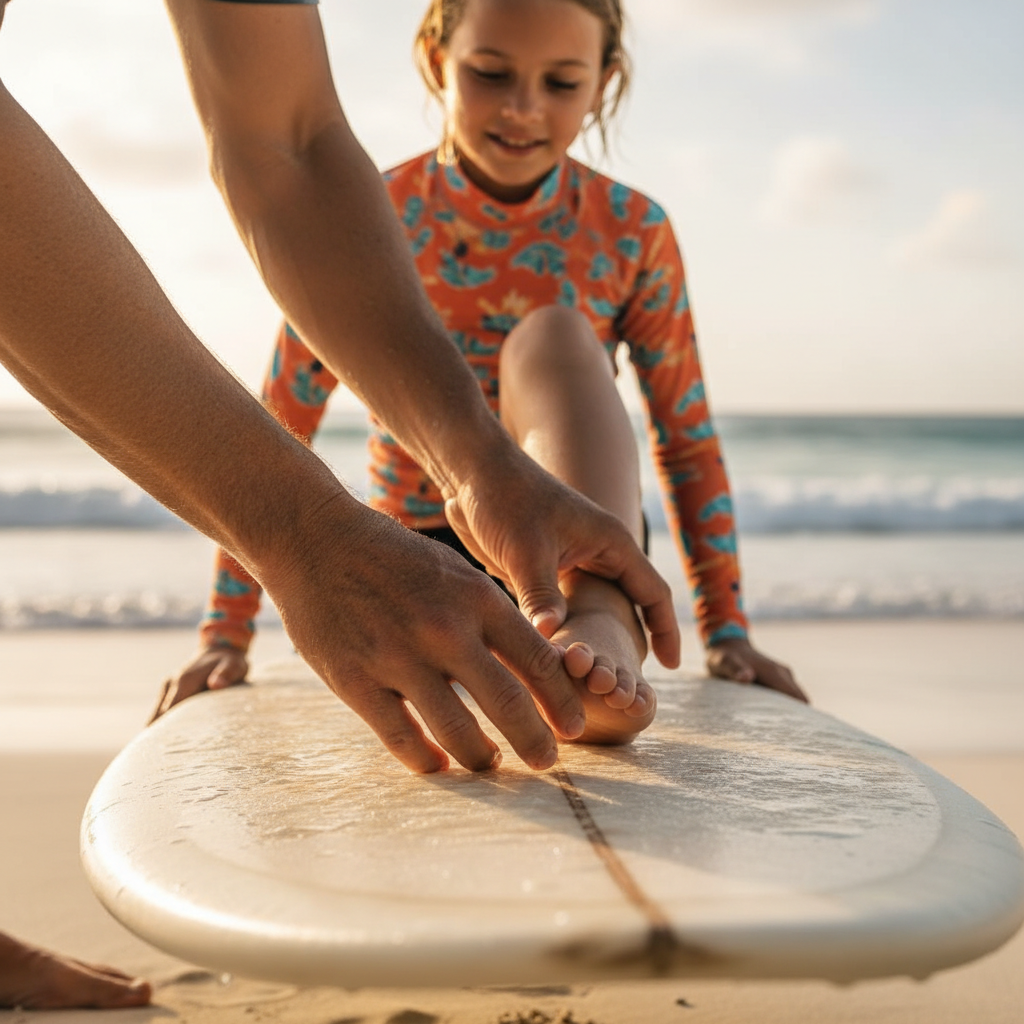
Determining Stance: Every skater is either "Regular" (left foot forward) or "Goofy" (right foot forward). To determine this, we observe which foot a student naturally leads with when starting to run or walking up a steep incline. There is no performance difference between the two; it is entirely a matter of natural neurological preference.
The 'Statue' Balance: Before the board ever rolls, the student must learn to stand on it while it is stationary. We often begin this on a high friction surface like grass or a thin carpet. The student practices standing with feet shoulder width apart, positioned directly over the deck bolts, with a slight bend in the knees to maintain a low center of gravity.
Proper Pushing: Once the student is comfortable standing, we transition to pavement. The key to stable pushing is keeping the front foot planted over the front bolts, pointing toward the nose, while the back foot pushes off the ground. In kids skateboarding for beginners, we emphasize keeping the weight centered over the board rather than leaning back, which prevents the board from shooting forward.
The 'Tic-Tac': This maneuver involves a subtle weight shift to the tail to lift the front wheels, followed by a small lateral pivot. This teaches the student how to navigate around small cracks or obstacles without stepping off the board.
Safe Stopping: The foot brake is the most essential safety skill. The student shifts their weight to the front leg and gently drags the flat sole of their back shoe on the concrete to create friction.
Learning these steps correctly from the start prevents the development of "bad habits," such as pushing with the front foot, which can be difficult to unlearn later. For parents who want to ensure their child’s first experience is grounded in these professional techniques, a free introductory lesson provides the perfect environment to assess their natural stance and balance. Establishing this foundation is a prerequisite for more advanced skateboarding lessons for kids.
Managing the Fear Factor: How to Fall Safely
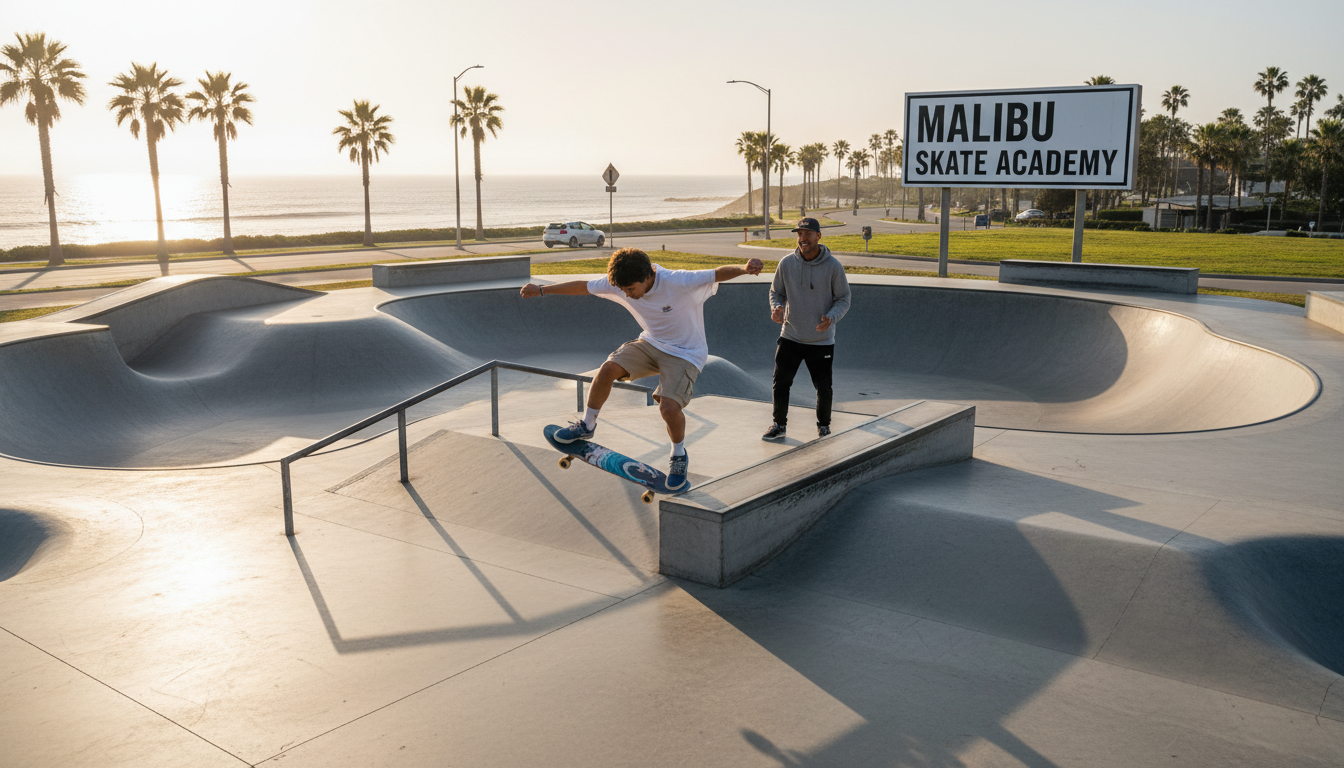
Mastering the physical mechanics is only half the battle; the psychological barrier of fear is often the most significant hurdle for new skaters. At Malibu Skate Academy, we teach that falling is not a failure of technique, but a fundamental part of the learning process. By removing the 'fear of the unknown' through proactive fall training, students gain the confidence to attempt new maneuvers during their skateboarding lessons for kids. This mental shift is essential when approaching kids skateboarding for beginners, as it replaces anxiety with a calculated understanding of risk management.
We focus on two primary techniques for mitigating impact. The first is the Kneepad Slide. When a student feels their balance shift forward, they are taught to drop directly onto their knee pads. The hard plastic caps allow them to slide along the concrete, safely dissipating the kinetic energy that would otherwise cause a jarring stop. The second is the Shoulder Roll, used when momentum is too great for a slide. By tucking the chin and rolling across the shoulder, the skater protects their head and wrists while distributing the force of the fall across the body’s largest muscle groups.
Parental response during these moments is a critical component of building resilience. When a fall occurs, we advise parents to remain calm and avoid rushing over with immediate alarm. Instead, perform a quick visual assessment and encourage the child to 'check the gear.' Pointing out a new scuff on a knee pad or wrist guard proves the equipment worked as intended. This shift in perspective transforms a potentially scary moment into a validation of their safety protocols. For parents who want their child to learn these resilience building techniques under professional supervision, our certified 1-on-1 coaching provides a structured environment for safely exploring these boundaries. New students can experience this approach first hand by booking a free introductory lesson.
Best Places for Beginner Kids to Skate in Malibu and Los Angeles
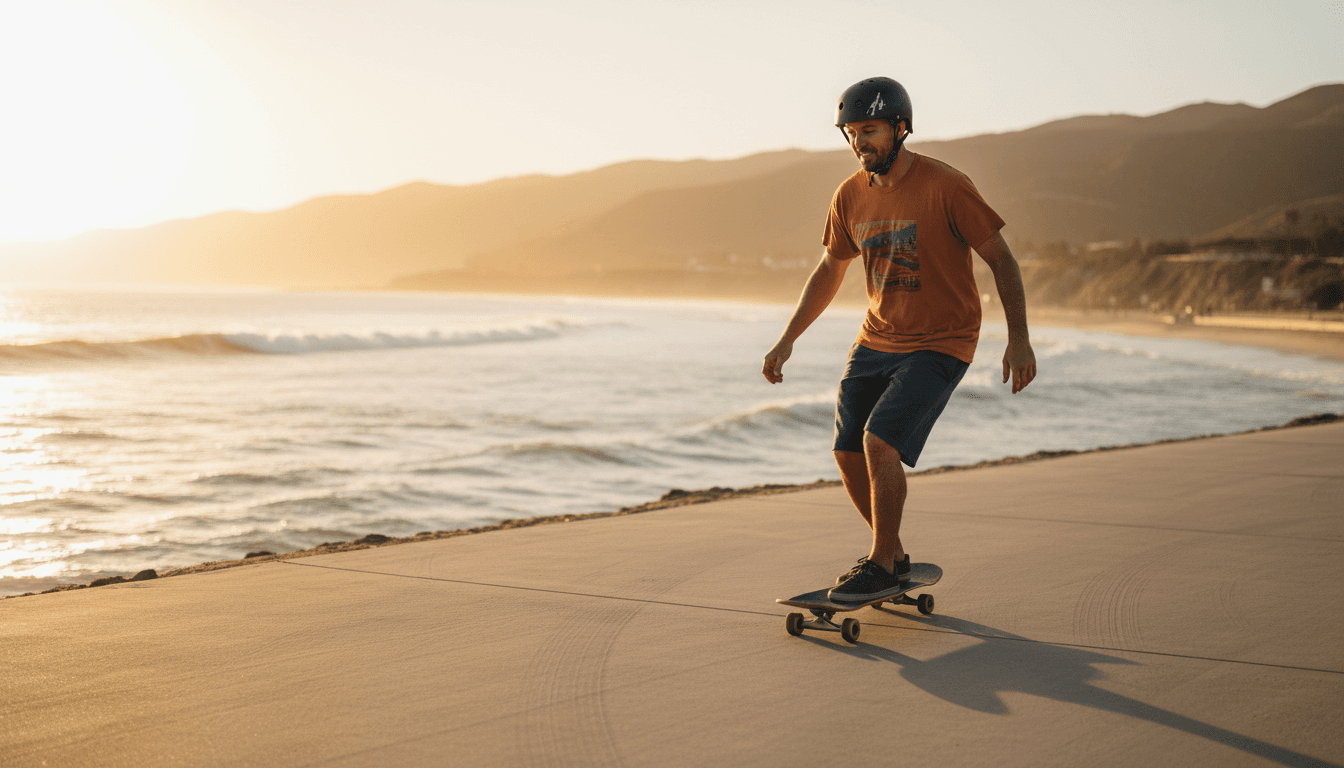
Building confidence after learning to fall requires the right environment. In Malibu, the boardwalks near Zuma Beach offer long stretches of smooth, flat pavement, making them ideal for practicing basic pushing and foot braking without the pressure of obstacles. For students in Westside Los Angeles, finding the mellow, flat sections of neighborhood parks is preferable to diving into high traffic zones. We recommend visiting local spots early in the morning, specifically avoiding the deep "pro" bowls during peak weekend hours when the speed and volume of experienced skaters can be intimidating for those just starting skateboarding lessons for kids.
Understanding skatepark etiquette is just as important as the physical skills. The most critical rule for kids skateboarding for beginners is avoiding "snaking," which is the act of cutting in line or crossing a skater's path while they are mid-run. Observing the flow and waiting for a clear opening ensures everyone stays safe and predictable. During certified 1-on-1 coaching, we guide students through these social dynamics, helping them navigate public spaces with poise. To identify the best local terrain for your child's current skill level, you can begin with a free introductory lesson at one of our preferred training locations.
Why Certified Coaching Beats Self-Teaching
Navigating the nuances of kids skateboarding for beginners is most effective with professional guidance. While parents provide vital encouragement, a certified coach identifies subtle posture mistakes that frequently develop into stubborn bad habits. Errors in weight distribution or shoulder alignment can hinder progress for months if left uncorrected. Certified 1-on-1 coaching provides the focused attention necessary to accelerate confidence and ensure technical precision from the very first push.
Malibu Skate Academy operates on a philosophy of clean, professional, and minimalist instruction tailored strictly to the individual’s pace. This individualized focus prevents the frustration that often occurs in group settings or self-taught environments. To experience this structured approach, families can start with a free introductory lesson to establish a safe, professional foundation for future skateboarding lessons for kids.
Skateboarding is an incredible way for children to build physical coordination and mental resilience. By focusing on the right safety gear and a supportive environment, you create a solid foundation for their new hobby. While starting at home is a wonderful first step, many families find that professional guidance helps kids progress more quickly and with fewer falls. If you want expert help to navigate those first few sessions, feel free to read more on our About page to learn more about our philosophy. We are here to support your child's journey.